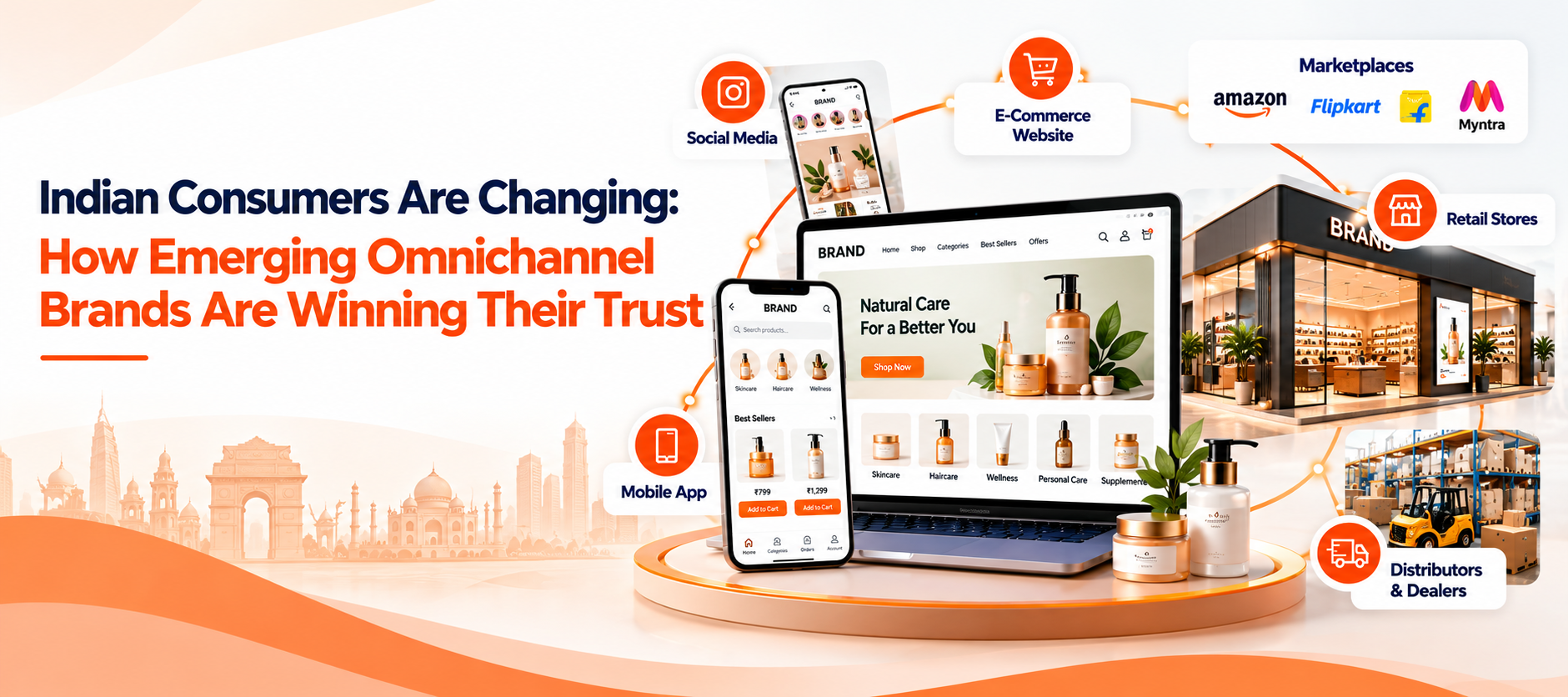
Indian Consumers Are Changing: How Emerging Omnichannel Brands Are Winning Their Trust
How India's new generation of shoppers is creating opportunities for emerging brands—and why omnichannel technology is becoming essential for business growth.
Introduction: A New Generation Is Changing Indian Retail
The Indian retail market is changing rapidly.
A few years ago, customers often preferred buying products from established brands with a long market presence, a large distribution network and recognizable retail stores.
Today, the buying behaviour of Indian consumers, especially younger generations, is evolving.
Customers are increasingly discovering new brands through Instagram, YouTube, influencers, online marketplaces and digital advertisements.
They are willing to try emerging brands if those brands offer good product quality, transparent information, competitive pricing, positive customer reviews and a convenient shopping experience.
A brand no longer needs decades of market presence or hundreds of physical stores to attract its first customers.
An emerging brand can build customer trust, establish a strong identity and expand across India by combining digital marketing, quality products and a connected omnichannel commerce experience.
This shift is creating significant opportunities for Indian entrepreneurs and growing consumer brands.
1. Indian Consumers Are More Open to Emerging Brands
Traditionally, brand recognition played a major role in purchasing decisions.
Customers often preferred familiar brands because they associated them with quality, reliability and service.
While established brands continue to hold significant advantages, younger consumers are increasingly willing to explore alternatives.
Today, a customer may discover a new skincare brand through Instagram, watch product reviews on YouTube, compare prices on Amazon and finally purchase directly from the brand's website.
The customer may never have visited the brand's physical store.
What matters is whether the brand can build confidence throughout the buying journey.
Some important factors influencing purchasing decisions include:
- Product quality and clear product information
- Customer ratings, reviews and recommendations
- Authentic brand communication
- Competitive pricing and attractive offers
- Convenient ordering and payment options
- Reliable delivery and return policies
- Responsive customer support
Trust is increasingly earned through customer experience, not simply through how long a brand has existed.
This gives emerging Indian brands an opportunity to compete with established companies.
2. Digital-First Brands Are Becoming Omnichannel Brands
Many successful emerging Indian consumer brands began by selling online.
They initially focused on social media, their own e-commerce websites and marketplaces.
As their customer base expanded, they began exploring physical retail stores, franchise networks, kiosks, shop-in-shop counters and distributor partnerships.
This approach allows brands to reach customers through multiple channels rather than depending on a single sales platform.
Several Indian brands demonstrate different aspects of this transition.
Snitch – Fashion for a New Generation
Snitch has built a recognizable menswear brand by focusing on contemporary fashion, digital engagement and younger consumers.
After establishing an online presence, the company expanded into physical retail stores.
Its growth illustrates how a digital-first fashion brand can extend its reach through offline retail.
NEWME – Connecting With Gen Z Shoppers
NEWME focuses on fashion preferences and shopping experiences for younger consumers.
The brand combines digital discovery with physical retail, creating opportunities for customers to engage through different shopping channels.
Nykaa – A Strong Omnichannel Beauty Example
Nykaa demonstrates how e-commerce and physical retail can work together in the beauty and personal care industry.
Customers can discover products online, explore different brands, read reviews and also visit physical stores to experience products.
Although Nykaa is now an established business rather than an emerging brand, its model demonstrates the value of combining digital convenience with physical customer experiences.
The Souled Store – Building a Brand Through Community
The Souled Store developed its identity around pop culture, fashion and customer communities.
Its expansion into physical retail shows how an online-first brand can create additional customer touchpoints beyond its website.
These examples highlight an important trend:
Indian brands are increasingly combining digital discovery, online commerce and physical retail to reach more customers and strengthen their relationships.
However, growth is not guaranteed simply by opening more sales channels. Product quality, unit economics, customer retention and operational execution remain essential.
3. Why Omnichannel Commerce Helps Build Customer Trust
Omnichannel commerce is more than selling products through multiple platforms.
It means connecting the entire customer shopping experience across online and offline channels.
Consider a customer purchasing a wellness product.
The customer might:
- Discover the brand through Instagram.
- Visit the brand's website to explore products.
- Check customer reviews and product information.
- Purchase the product through a marketplace.
- Visit a nearby franchise store for the next purchase.
- Receive personalized offers through WhatsApp.
- Reorder through the brand's mobile application.
Although the customer interacts with different sales channels, the brand should provide a consistent experience.
Product information, pricing policies, loyalty benefits and customer support should remain coordinated wherever possible.
This consistency helps build confidence.
Customers should experience one brand, not multiple disconnected sales channels.
That is the real value of omnichannel commerce.
4. Emerging Brands Can Grow Without Opening Hundreds of Stores
Earlier, expanding a consumer brand across India often required significant investment in physical distribution.
Brands needed distributors, dealers, warehouses, retail partners and marketing infrastructure.
Today, businesses have more options.
An emerging brand can start with its own e-commerce website, expand through marketplaces, introduce a customer mobile app and gradually build franchise or distributor networks.
For example, a growing wellness brand may use:
- E-Commerce Website: Direct sales to customers across India.
- Marketplaces: Additional reach through Amazon, Flipkart and other platforms.
- Franchise Stores: Physical customer experiences and local brand presence.
- Distributors and Dealers: Access to regional retail networks.
- Mobile App: Repeat purchases, membership benefits and customer engagement.
- Shop-in-Shop and Kiosks: Retail expansion without operating a full independent store.
- Corporate Sales: Bulk orders and institutional customers.
Each channel can create additional opportunities for customer acquisition and revenue.
However, as the number of channels increases, business operations become more complex.
This is where connected technology becomes important.
5. The Biggest Challenge: Managing Multiple Sales Channels
Many emerging brands begin with separate software systems.
They may use one application for inventory, another for retail billing, a different platform for e-commerce and Excel sheets for distributor management.
This approach may work during the early stages.
But as the business grows, disconnected systems can create operational problems.
Inventory Visibility
A product may be available in one warehouse but unavailable in another store.
Without centralized inventory information, the sales team may struggle to identify available stock.
Different Product Information
Product descriptions, SKUs, pricing and images may differ between websites, marketplaces and retail systems.
Franchise Management
As franchise stores increase, managing stock transfers, replenishment, pricing and sales reporting becomes more difficult.
Customer Data
Customers may purchase through different channels, but their purchase history and loyalty information may remain disconnected.
Reporting and Business Decisions
Management may need to combine information from multiple software systems to understand overall sales, stock, profitability and channel performance.
Opening more sales channels should increase business opportunities—not multiply operational problems.
A growing brand needs technology that can connect its operations.
6. Why a Connected Omnichannel Platform Matters
A connected omnichannel commerce platform helps businesses manage multiple sales channels through a coordinated technology ecosystem.
Instead of maintaining separate product catalogues, disconnected inventory records and independent customer databases, businesses can establish shared information and integrated workflows.
An effective omnichannel platform should support four important foundations.
One Product Catalogue
Maintain consistent product information, SKUs, variants, images and categories across sales channels.
One Inventory Ecosystem
Connect warehouses, retail stores, franchises and online channels to improve stock visibility and inventory movement.
One Customer View
Bring together customer information, purchase history, loyalty benefits and engagement activities where integrations and customer permissions allow.
Every Sales Channel Connected
Integrate retail POS, e-commerce websites, mobile applications, franchise stores, distributors and marketplaces.
With these foundations, businesses can improve operational visibility and support more consistent customer experiences.
7. How Upstair Technologies Helps Build Strong Omnichannel Brands
At Upstair Technologies LLP, we understand that building a successful consumer brand requires more than an attractive website or a mobile application.
As a brand grows, it needs a technology foundation that can support product management, inventory, retail sales, distribution, customer engagement and business analytics.
We help businesses design and develop connected commerce solutions based on their specific operating models.
Through our SellUnified OmniCommerce platform and custom software development capabilities, we help emerging and growing brands establish a stronger digital and operational infrastructure.
Our solutions can support:
Product & Inventory Management
Centralized product catalogues, SKUs, variants, warehouses, stock transfers and inventory visibility.
Retail POS & Franchise Management
Retail billing, store operations, franchise networks, stock replenishment and centralized business controls.
E-Commerce Website & Customer Mobile App
Branded online shopping experiences, product discovery, customer accounts and digital ordering.
Distributor & Dealer Management
B2B ordering, partner networks, distribution workflows and channel-specific business requirements.
Customer Loyalty & CRM
Loyalty points, memberships, gift cards, coupons, customer engagement and promotional campaigns.
Marketplace & Third-Party Integrations
Connecting external marketplaces, payment services, shipping providers, accounting applications and other business systems through supported integrations.
Reports & Business Analytics
Centralized visibility into sales, inventory, customers, stores and channel performance.
Our focus is to help businesses build a connected technology ecosystem rather than depend on multiple isolated applications.
Designed for Different Consumer Industries
Upstair's omnichannel solutions are particularly relevant for brands operating in:
- Wellness and nutraceuticals
- Cosmetics and beauty
- FMCG and packaged consumer products
- Beverages
- Lifestyle and specialty retail
Whether a business is launching its first online store or expanding into a national franchise and distributor network, the technology should be designed around its business model and growth plans.
8. Technology Should Grow Along With the Brand
A common mistake businesses make is choosing technology only for their immediate requirements.
A brand may initially need a website and basic order management.
After a few months, it may want to introduce a warehouse, franchise stores, distributors, a mobile app or a loyalty program.
If the original technology cannot support these changes, the business may need to invest in additional software or rebuild existing systems.
This can increase cost and operational complexity.
A scalable omnichannel architecture allows businesses to introduce additional capabilities as their requirements evolve.
For example:
Stage 1 – Brand Launch
Product catalogue, e-commerce website, payment integration and basic inventory management.
Stage 2 – Customer Growth
CRM, loyalty programs, marketing integrations and mobile commerce.
Stage 3 – Retail Expansion
Retail POS, franchise management, multi-location inventory and warehouse operations.
Stage 4 – Distribution & Scale
Distributor management, B2B ordering, advanced reporting and enterprise integrations.
Not every brand needs every feature from the beginning.
The important thing is to build a technology foundation that supports future expansion without unnecessary complexity.
9. The Future of Indian Retail Belongs to Customer-Focused Brands
India's younger consumers are creating new opportunities for entrepreneurs and emerging brands.
Customers have more choices, more information and more ways to discover and purchase products than ever before.
This means brands must compete not only through pricing and product quality but also through convenience, transparency, reliability and customer experience.
An emerging brand can build a strong customer following through digital channels, strengthen trust through physical retail and expand its reach through connected distribution networks.
However, successful omnichannel growth requires coordination between technology, operations, marketing and customer service.
The brands that manage these elements effectively will be better positioned to build lasting customer relationships.
Conclusion: Building the Next Generation of Indian Omnichannel Brands
Indian consumers are changing, and the way brands reach them must change too.
A strong brand is no longer defined only by its age, advertising budget or number of physical stores.
Emerging brands can build customer trust through quality products, authentic communication, digital engagement and consistent shopping experiences.
Omnichannel commerce gives these brands an opportunity to connect with customers across websites, marketplaces, retail stores, franchise networks and mobile applications.
But to manage this growth effectively, businesses need a connected technology ecosystem.
At Upstair Technologies, we help emerging and established businesses build the software infrastructure required to create, manage and scale strong omnichannel brands.
From e-commerce and retail POS to franchise management, distribution, inventory and customer engagement, our goal is to help businesses connect their operations and deliver better customer experiences.
The next generation of successful Indian brands will not simply sell through more channels. They will connect every channel to create one trusted brand experience.
About Upstair Technologies
Upstair Technologies LLP is a software development company specializing in custom business applications, ERP solutions, omnichannel commerce platforms, retail POS, inventory management, franchise management and system integrations.
Through SellUnified, we help consumer brands build connected commerce ecosystems across online and offline sales channels.
Website: www.upstairtechnologies.com
Omnichannel Platform: www.sellunified.com
Technology should adapt to your business—not the other way around.
Certified With The Highly Top-Rated Company
Upstair Technologies Is A Leading IT Company And It Is Certified As The Highly Top-rated Company On Good firms, Clutch, And Upwork. We Also Have A Great Client On Upwork Across The Globe.


Get In Touch With Us
Are You Ready To Grow Your Business With Us?
Drop us a message
We will get back to you as soon as possible.

India

C2-710, Pragati IT Park, Opp AR Mall, Mota Varachha, Surat, Gujarat 394101


USA
108 OGDEN AVE APT 201, JERSEY CITY, NEW JERSEY Zip Code : 07307