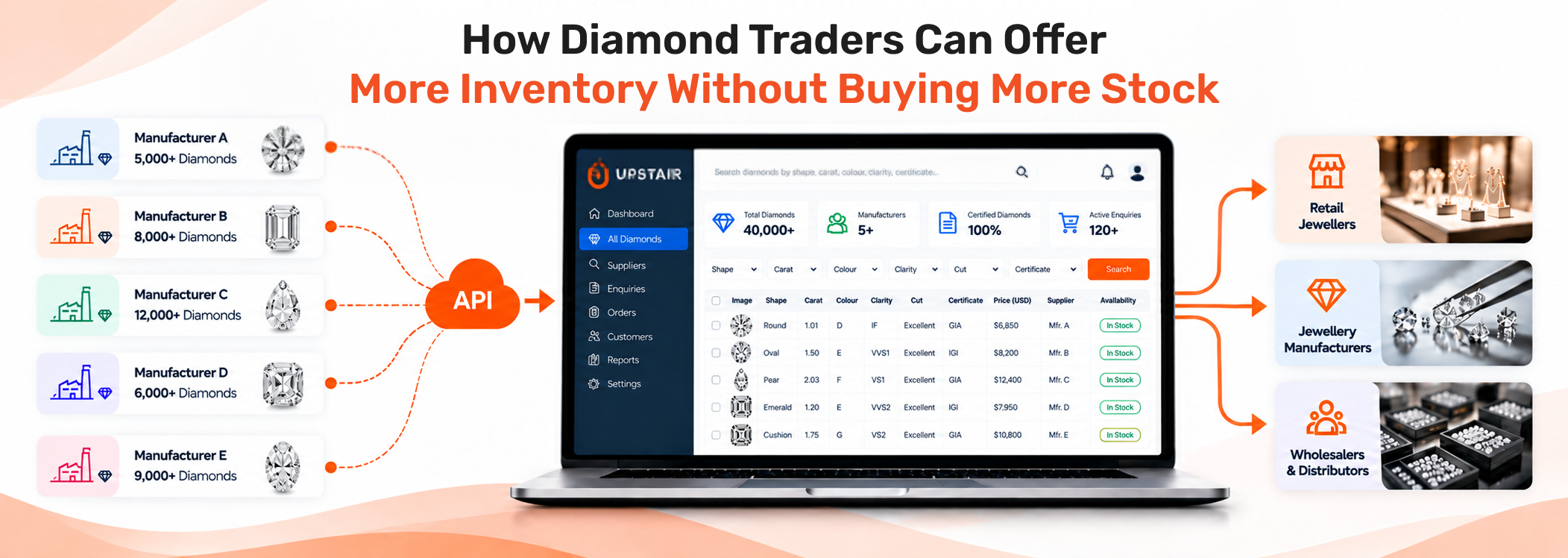
How Diamond Traders Can Offer More Inventory Without Buying More Stock
How technology helps diamond traders connect multiple manufacturers, offer thousands of certified diamonds and grow their business without investing heavily in physical inventory.
Introduction
In the diamond trading business, having a larger inventory means more opportunities to serve customers.
Retail jewellers, jewellery manufacturers and wholesalers often look for diamonds with specific combinations of shape, carat weight, colour, clarity, cut and certification.
However, maintaining a large physical inventory requires significant investment. Buying more diamonds means more capital is tied up in stock, along with the risk of slow-moving inventory.
But what if a diamond trader could offer thousands of additional diamonds without purchasing them first?
Technology makes this possible by connecting the inventory of multiple diamond manufacturers through one centralized digital platform.
At Upstair Technologies, we have designed and developed a solution for a diamond trading client that connects multiple diamond manufacturers through APIs and brings their certified diamond inventory into one platform.
This allows the trader to offer a much larger diamond selection to retailers and jewellers without needing to own every listed stone.
1. The Challenge: Customers Want More Choices
Every diamond buyer has different requirements.
One customer may need a 1-carat round diamond with excellent cut, while another may be looking for a 2-carat oval diamond with a specific colour, clarity and certification.
A trader with limited physical inventory may not always have the exact diamond a customer needs.
To fulfil these requirements, traders traditionally contact multiple manufacturers, request updated stock lists, compare available stones and confirm prices.
This process can be time-consuming, especially when dealing with hundreds of suppliers and thousands of diamonds.
The challenge is simple: customers expect more choices, but maintaining every possible diamond combination in physical stock is expensive.
2. The Solution: Connect Multiple Diamond Manufacturers on One Platform
Instead of purchasing diamonds from every manufacturer, a trader can create a centralized digital inventory platform.
Each participating diamond manufacturer connects its existing inventory system to the trader's platform through an API.
The manufacturer's available certified diamonds are then shared with the central system.
The trader can present this combined inventory to retailers, jewellers and other B2B buyers through one digital catalogue.
How it works
Diamond Manufacturers → API Integration → Central Diamond Inventory Portal → Diamond Traders → Retailers & Jewellers
For example, consider a trader connected to five diamond manufacturers:
- Manufacturer A — 5,000 available diamonds
- Manufacturer B — 8,000 available diamonds
- Manufacturer C — 12,000 available diamonds
- Manufacturer D — 6,000 available diamonds
- Manufacturer E — 9,000 available diamonds
- Total Combined Inventory — 40,000 diamonds
This is an illustrative example, not actual customer inventory data.
Through one platform, the trader can potentially offer access to 40,000 diamond listings, subject to current stock availability and duplicate checks.
The trader does not necessarily need to purchase all these diamonds in advance.
This creates a more flexible and scalable diamond trading model.
3. How API Integration Makes This Possible
API integration is the technology that connects different manufacturers' inventory systems to the central diamond trading platform.
Each manufacturer may already be using its own ERP or diamond inventory management software.
Instead of asking every supplier to manually upload Excel files, the platform can receive inventory information through an API connection.
The shared information can include:
- Diamond ID and certificate number
- Certification laboratory, such as GIA or IGI
- Diamond shape and carat weight
- Colour, clarity and cut
- Polish, symmetry and fluorescence
- Measurements and grading information
- Supplier price and availability
- Diamond images, videos and certificate links, where available
The central platform organizes this information into a common format, making diamonds from different suppliers searchable through one catalogue.
Manufacturers can continue using their existing software while sharing inventory with the trader.
This reduces the need for repeated manual data entry and helps keep supplier information connected.
4. One Search Across Thousands of Certified Diamonds
For retailers and jewellers, the biggest advantage is having access to a wider diamond selection in one place.
A buyer can search the platform using filters such as:
Shape → Carat → Colour → Clarity → Cut → Certification → Price
For example, a retailer looking for a 1.50-carat oval diamond can search the combined inventory rather than contacting multiple manufacturers individually.
The platform can display matching diamonds from different suppliers, allowing buyers to compare specifications, availability and prices.
This makes diamond sourcing more convenient and gives traders an opportunity to serve more customer requirements.
5. Maintaining Accurate Inventory Availability
One of the biggest challenges in this business model is keeping inventory information updated.
A manufacturer may sell a diamond through another sales channel while the same diamond is still listed on the trader's platform.
Without proper inventory synchronization, the trader could offer a diamond that is no longer available.
A well-designed system should support:
- New diamond inventory updates
- Price and specification changes
- Sold or unavailable diamond removal
- Duplicate certificate identification
- Supplier-wise inventory tracking
- Availability confirmation before order finalization
The frequency of synchronization depends on the API capabilities and integration arrangements with each manufacturer.
Accurate availability is essential because a large diamond catalogue is valuable only when buyers can rely on the information displayed.
6. How Diamond Traders Benefit From This Model
A connected diamond inventory platform can create several important business advantages.
Larger Inventory Without Large Stock Investment
Traders can offer supplier-owned diamonds without purchasing every stone in advance.
This reduces the need to invest heavily in additional physical inventory.
More Choices for Customers
A wider catalogue helps traders serve buyers looking for different diamond shapes, sizes, qualities and certifications.
Faster Diamond Sourcing
Instead of contacting multiple suppliers for every enquiry, the sales team can search available diamonds through one centralized platform.
Better Supplier Network
The trader can connect additional manufacturers and expand the available catalogue as the business grows.
More Scalable Operations
As the supplier network and customer base increase, a digital platform can help manage the growing volume of inventory data and buyer enquiries.
Better Working Capital Management
By reducing the need to purchase every listed diamond in advance, the trader may preserve more working capital for sales, operations and business expansion.
The actual financial benefit depends on supplier agreements, payment terms and the trader's commercial model.
7. Managing Diamond Prices and Customer-Specific Margins
Diamond prices can vary between manufacturers based on specifications, quality, availability and commercial terms.
A centralized trading platform can be designed to support supplier-wise pricing and trader markup policies.
For example:
Supplier Price + Trader Markup + Applicable Charges = Customer Selling Price
Different B2B customers may also have different pricing agreements.
A centralized pricing system can help traders apply consistent commercial rules without manually calculating the selling price of every diamond.
This becomes particularly important when managing thousands of diamond listings from multiple suppliers.
8. Creating a Better Buying Experience for Retailers and Jewellers
Retail jewellers need quick access to diamond availability when preparing customer quotations or finalizing jewellery orders.
A digital diamond sourcing platform can support a more convenient buying process.
Retailers can search certified diamonds, review specifications, compare available options and submit enquiries or purchase requests through one system.
Depending on the business requirements, additional features can include customer-specific pricing, saved searches, diamond shortlisting, quotation generation, order tracking and digital certificates.
This creates an opportunity for diamond traders to build stronger relationships with their B2B customers through technology.
9. How Upstair Technologies Developed This Solution
At Upstair Technologies, we worked with a diamond trading business that wanted to offer a much larger certified diamond inventory to its customers without maintaining all the diamonds in its own physical stock.
The business model involved connecting multiple smaller diamond manufacturers, each maintaining its own inventory, with one centralized platform.
Our technology solution was designed around three key requirements.
Connecting manufacturers: Allow participating diamond manufacturers to share their available stock through API integrations.
Centralizing inventory: Bring diamond information from multiple suppliers into one structured digital platform.
Expanding buyer access: Enable the diamond trader to present the combined inventory to retailers and jewellers through its sales ecosystem.
The important part of this solution is that manufacturers do not necessarily need to replace their existing inventory software.
Instead, their systems can connect to the central platform through APIs.
This approach helps the trader create a larger digital inventory network while allowing manufacturers to continue managing their own stock.
It demonstrates how custom software development and system integration can support new business models in the diamond industry.
10. The Same Technology Can Work Across Other Industries
Although this solution was designed for diamond trading, the same concept can be applied to many other businesses.
For example:
- Jewellery wholesalers connecting multiple manufacturers
- Gemstone traders aggregating supplier stock
- Engineering distributors sourcing components from different factories
- Automobile spare parts marketplaces connecting multiple suppliers
- Electronics wholesalers combining distributor inventory
- B2B marketplaces connecting manufacturers and retailers
In each case, inventory remains distributed across different suppliers, while buyers access the available products through one centralized platform.
The business does not always need to own the inventory. It needs reliable access to the inventory and an efficient way to connect suppliers with buyers.
Conclusion: Grow Your Diamond Business Through Connectivity
In diamond trading, offering more choices can create more opportunities to serve retailers, jewellers and wholesale customers.
However, building a large physical inventory is not the only way to achieve this.
By connecting multiple diamond manufacturers through APIs, traders can create a centralized catalogue containing thousands of certified diamonds.
This approach can help expand product availability, reduce manual sourcing efforts and support business growth without requiring the trader to purchase every listed stone.
At Upstair Technologies, we believe technology should help businesses create smarter operating models, not simply digitize existing processes.
You don't need to buy more stock to offer more diamonds. You need the right technology to connect the stock already available across your supplier network.
About Upstair Technologies
Upstair Technologies LLP specializes in custom software development, ERP solutions, B2B platforms, inventory management, API integrations and digital commerce solutions.
We help businesses connect complex operations, integrate existing software systems and build scalable technology platforms based on their specific requirements.
Website: https://www.upstairtechnologies.com/
Certified With The Highly Top-Rated Company
Upstair Technologies Is A Leading IT Company And It Is Certified As The Highly Top-rated Company On Good firms, Clutch, And Upwork. We Also Have A Great Client On Upwork Across The Globe.


Get In Touch With Us
Are You Ready To Grow Your Business With Us?
Drop us a message
We will get back to you as soon as possible.

India

C2-710, Pragati IT Park, Opp AR Mall, Mota Varachha, Surat, Gujarat 394101


USA
108 OGDEN AVE APT 201, JERSEY CITY, NEW JERSEY Zip Code : 07307