Why Supply Chain Management Software Is Essential for Modern Businesses
From procurement to production and final delivery, connected technology helps businesses improve visibility, reduce operational inefficiencies and build a more scalable organization.
Modern businesses operate through increasingly complex supply chains. Whether an organization is involved in manufacturing, engineering, distribution, wholesale or retail, its success depends on how efficiently materials, information and products move across different departments and business partners.
A typical business supply chain involves suppliers, purchasing teams, warehouses, production departments, quality control, logistics partners and customers.
When these activities are managed through disconnected software, Excel sheets, emails and manual records, organizations often struggle with delayed information, inventory inaccuracies, production bottlenecks and limited operational visibility.
Supply chain management software helps connect these processes into a structured digital ecosystem, enabling businesses to make faster decisions and maintain better control over operations.
1. Connecting the Complete Supply Chain
Supply chain management is much more than purchasing materials and dispatching finished products.
It involves coordinating multiple business processes, from identifying material requirements to fulfilling customer orders.
A connected system can bring together:
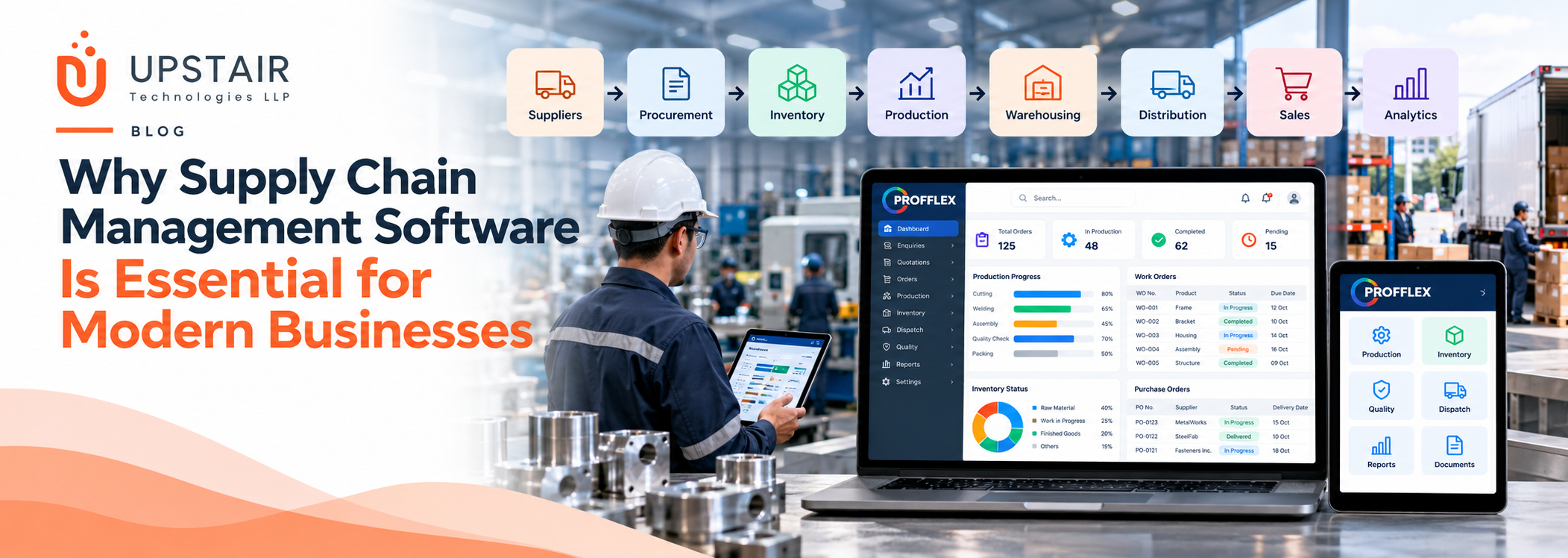
Supplier Management → Procurement → Material Inward → Inventory → Production → Quality Control → Warehousing → Dispatch → Customer Delivery
Instead of departments maintaining separate records, information can move through a common digital platform.
For example, when a manufacturing order is created, the organization can check material requirements, review available inventory, identify shortages and coordinate purchasing activities.
This helps reduce communication gaps and improves coordination between teams.
2. Better Procurement and Supplier Management
Procurement plays an important role in controlling business costs and maintaining uninterrupted operations.
Without centralized purchasing information, businesses may face duplicate orders, delayed approvals, inconsistent supplier pricing and poor visibility into pending materials.
A structured procurement system can help organizations manage purchase requisitions, supplier quotations, purchase orders, material inward, purchase returns and supplier performance.
Management can review purchasing history, compare supplier prices and monitor outstanding orders.
This improves purchasing discipline and supports more informed procurement decisions.
3. Real-Time Inventory Visibility
Inventory is one of the most important components of the supply chain.
Excess stock increases working capital requirements, while insufficient stock can interrupt production or delay customer orders.
Businesses need visibility into available stock, reserved materials, work-in-progress, finished goods and warehouse-wise inventory.
A centralized inventory system can help answer important questions:
- What materials are currently available?
- Which materials are required for upcoming production?
- Which items are moving slowly?
- What stock is reserved against customer orders?
- Which warehouse has the required material?
- When should additional material be purchased?
With accurate inventory information, businesses can reduce unnecessary purchasing, improve stock utilization and make better replenishment decisions.
4. Connecting Manufacturing With Supply Chain Operations
For manufacturing and engineering organizations, supply chain efficiency depends heavily on production visibility.
A purchase order alone does not provide the complete picture. Management also needs to understand how materials are issued, consumed, processed and converted into finished products.
A connected manufacturing system can manage production jobs, work stages, employee assignments, material consumption, quality checks and finished goods reporting.
When production information is digitally available, purchasing and planning teams can respond more effectively to actual manufacturing requirements.
This is particularly important for organizations managing multiple production departments, job-work processes or project-based manufacturing activities.
5. Improving Production Planning and Reducing Delays
Production delays are not always caused by machine problems.
They can also result from missing materials, incomplete documentation, unclear task assignments, delayed approvals or poor coordination between departments.
Digital production management provides better visibility into ongoing work, pending tasks, production stages and potential bottlenecks.
Supervisors can identify which jobs are progressing, which activities are delayed and where additional attention is required.
This improves accountability and helps management take corrective action before small delays affect customer commitments.
6. Better Cost Control and Profitability
Every supply chain activity contributes to the final cost of a product.
These costs may include raw materials, purchasing, transportation, labour, manufacturing operations, inventory storage, subcontracting and delivery.
When information is scattered across departments, understanding actual operational costs becomes difficult.
Connected software can provide the data needed to analyse material consumption, procurement expenses, production efficiency and inventory movement.
With appropriate costing capabilities, organizations can also compare estimated costs against actual expenses and identify opportunities to improve profitability.
The objective is not simply to reduce expenses. It is to understand where costs are generated and how operations can become more efficient.
7. Better Coordination Between Warehouses, Production and Sales
Growing businesses often operate across multiple locations, including factories, warehouses, project sites, distribution centres and customer-facing operations.
Without connected information, one department may not know what another department has already purchased, produced, reserved or dispatched.
A centralized system improves coordination by maintaining a consistent view of orders, materials and operational activities.
For example, the sales team can obtain better information about order progress, while production teams can plan work based on confirmed customer requirements.
This helps organizations provide more reliable delivery commitments and improve customer service.
8. Management Reporting and Business Visibility
Business owners and senior management need more than transaction records. They need meaningful information that supports decisions.
A connected supply chain and operations platform can provide reports such as purchase order status, supplier performance, inventory movement, material consumption, production progress, pending jobs, quality results and dispatch performance.
Instead of spending time collecting information from different departments, management can focus on analysing business performance.
This becomes increasingly valuable as the organization expands its operations, employees, customers and locations.
9. Profflex: Digitizing Manufacturing and Shop Floor Operations
At Upstair Technologies, we understand that supply chain efficiency cannot be achieved through procurement and inventory management alone. Manufacturing operations, employee coordination, production tracking and customer order management are equally important.
To address these challenges, we have developed Profflex — a digital manufacturing and shop floor management platform designed to help engineering and manufacturing businesses streamline their day-to-day operations.
Profflex — Manufacturing & Shop Floor Management
Profflex connects manufacturing jobs, production stages, employees, engineering documentation and customer-facing workflows through a cloud-based web platform and an Android tablet application for shop floor teams.
Profflex includes capabilities such as real-time production tracking, engineering document management, task and staff management, centralized site and shop management, operational reports, and CRM workflows covering enquiries, quotations, orders and deliveries.
For engineering manufacturers, it also provides features related to welding documentation, including WPS, PQR and weld planning.
These capabilities support an important part of the wider supply chain: turning customer requirements into organized, trackable manufacturing operations.
Profflex is focused on manufacturing and shop floor management rather than being presented as a complete end-to-end supply chain suite. Depending on the organization's requirements, additional procurement, inventory, warehouse and other business systems can form part of a broader connected solution.
Explore Profflex: www.profflex.in
10. Building Connected Business Solutions With Upstair Technologies
Every organization has its own supply chain structure, approval processes, production workflows and operational challenges.
A standard software package may address some requirements, but growing businesses often need customized workflows and integrations with their existing applications.
At Upstair Technologies, our approach starts with understanding how the business operates.
We help organizations design and develop software solutions that connect purchasing, inventory, manufacturing, distribution, sales and management reporting according to their business requirements.
Our objective is to help businesses move from disconnected processes to a more structured, scalable and digitally connected operating environment.
Conclusion: A Connected Supply Chain Creates a Stronger Business
Supply chain management software is becoming increasingly important for organizations that want better control over operations, inventory, production costs and customer commitments.
As businesses grow, relying on manual coordination and disconnected information can create operational inefficiencies that become difficult to manage.
The right combination of supply chain software, manufacturing management tools and system integrations can improve visibility, coordination and decision-making.
With solutions such as Profflex, Upstair Technologies is helping manufacturing businesses take practical steps toward digitizing their operations.
A smarter supply chain is not simply about moving materials faster. It is about connecting people, processes and information so the entire organization can work more efficiently.
Technology should adapt to your business processes—not force your business to adapt to technology.
Certified With The Highly Top-Rated Company
Upstair Technologies Is A Leading IT Company And It Is Certified As The Highly Top-rated Company On Good firms, Clutch, And Upwork. We Also Have A Great Client On Upwork Across The Globe.



Get In Touch With Us
Are You Ready To Grow Your Business With Us?
Drop us a message
We will get back to you as soon as possible.

India

C2-710, Pragati IT Park, Opp AR Mall, Mota Varachha, Surat, Gujarat 394101


USA
108 OGDEN AVE APT 201, JERSEY CITY, NEW JERSEY Zip Code : 07307