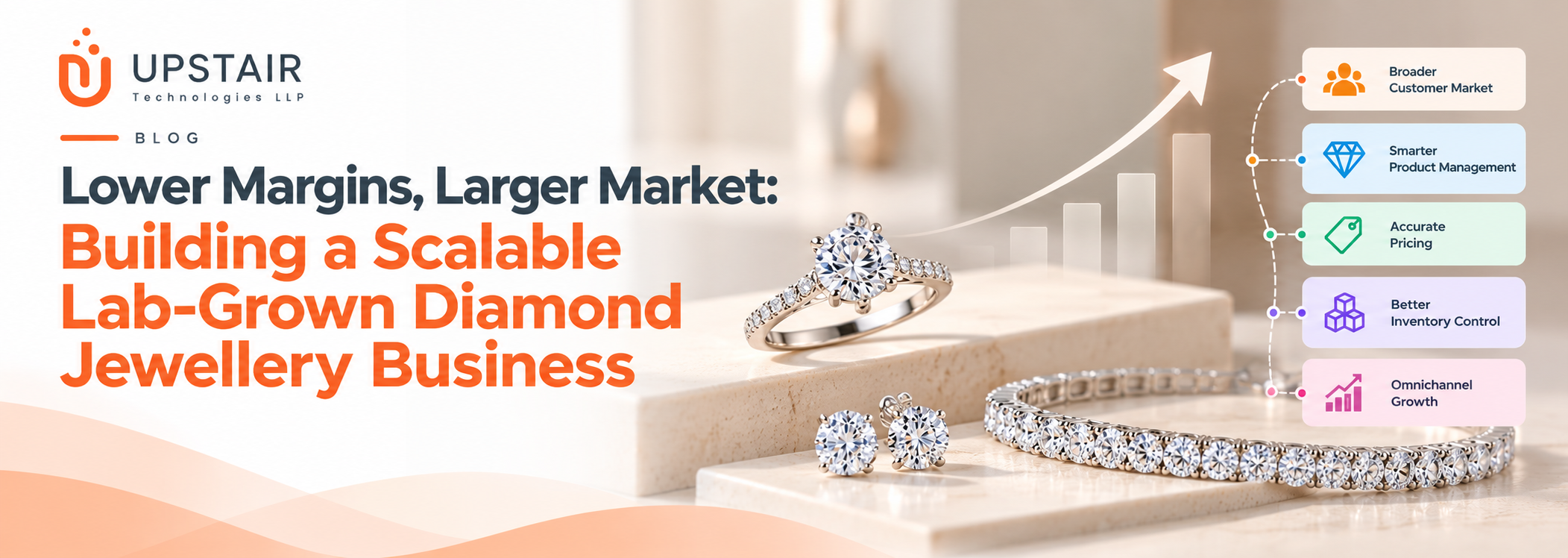
Lower Margins, Larger Market: Building a Scalable Lab-Grown Diamond Jewellery Business
The lab-grown diamond jewellery market is creating a different kind of opportunity for jewellery businesses.
Compared with traditional high-value jewellery models, lab-grown diamonds can make diamond jewellery accessible to a broader customer base. But this opportunity also creates a new business challenge: when margins become tighter and competition increases, operational efficiency becomes much more important.
A business cannot depend only on higher margins per piece. It needs to think about volume, inventory movement, product variety, pricing accuracy, faster sales cycles and operational control.
For lab-grown diamond jewellery businesses, technology can become an important part of making this model scalable.
Lower Margins Change the Way the Business Needs to Operate
In a high-margin business, some operational inefficiencies can remain hidden.
When margins are tighter, every additional cost starts to matter.
Excess inventory, incorrect pricing, slow-moving designs, unnecessary stock transfers, manual data entry, poor purchasing decisions and inefficient fulfilment can directly affect profitability.
The focus therefore needs to move from only:
“How much margin do we make on this jewellery piece?”
to:
“How efficiently can we sell, replenish and manage thousands of jewellery pieces?”
This is where a scalable retail and ERP platform becomes important.
More Accessible Pricing Can Create a Larger Customer Market
Lab-grown diamonds can allow brands to offer larger stones and a wider range of diamond jewellery at price points that may attract a broader group of customers.
This can create opportunities across:
- Everyday Jewellery
- Fashion Jewellery
- Bridal
- Gifting
- Occasion Wear
- Online Sales
- Multi-Store Retail
- B2B
But serving a larger market also means managing more customers, more transactions and potentially significantly more product variations.
The technology infrastructure behind the brand must be prepared for that scale.
One Design Can Become Many SKUs
Diamond jewellery already has considerable product complexity.
One ring design could potentially be offered with different:
- Diamond Shapes
- Carat Sizes
- Colours
- Clarities
- Metal Colours
- Metal Karats
- Ring Sizes
The result can be dozens of variants from a single design.
As the catalogue grows, managing every combination manually becomes increasingly difficult.
A jewellery-focused ERP can maintain a structured relationship between:
Style → Variant → SKU → Diamond → Metal → Cost → Selling Price → Inventory
This gives the business the flexibility to offer product variety without losing control of its catalogue.
Pricing Needs to Be Fast and Accurate
A scalable lab-grown diamond jewellery business also needs a strong pricing engine.
The selling price can include:
Metal Value + Diamond Value + Other Stones + Making Charges + Certification + Other Costs + Margin + Taxes
Changes in diamond specifications, metal karat or product weight can immediately affect the final price.
For B2B operations, the complexity can increase further because different customers may have different diamond rates, labour charges, discounts or markup structures.
Instead of depending on manual calculations, a centralized pricing engine can make quotation and selling prices faster and more consistent.
Inventory Turnover Becomes Critical
When operating at tighter margins, holding the wrong inventory can become expensive.
Management needs visibility into questions such as:
- Which designs are selling quickly?
- Which SKUs have not moved?
- Which diamond sizes are in demand?
- What is available across stores and warehouses?
- Which products should be replenished?
- Which inventory can be transferred instead of purchased again?
A centralized inventory platform can provide visibility across finished jewellery, loose diamonds, stores, warehouses and sales channels.
Better visibility can help a business use existing inventory more effectively before investing in additional stock.
Connect Retail, B2B and Digital Commerce
A scalable lab-grown diamond brand does not necessarily need to depend on one sales channel.
The same product catalogue can potentially support:
- Retail Stores
- Franchise Stores
- B2B Customers
- E-Commerce
- Mobile Apps
- Marketplaces
- Exhibitions
The important part is keeping these channels connected.
If a product sells through a retail store, inventory should be reflected across the ecosystem. If pricing changes, the relevant channels should receive the updated price. If a customer purchases online and later visits a store, the business should be able to maintain a connected customer history.
This is the foundation of omnichannel jewellery retail.
B2B Can Become Digital Too
Lab-grown diamond jewellery manufacturers and wholesalers can also use technology to expand their B2B operations.
Instead of sending catalogues, Excel sheets and prices manually to every customer, a B2B portal can allow authorized buyers to:
- Browse collections
- Search available stock
- Select variants
- View their applicable prices
- Request quotations
- Place orders
- Track previous transactions
Customer-specific pricing can be generated through the same centralized pricing engine.
This can help the sales team serve a larger customer network without increasing manual work at the same rate.
Understand Profitability at Product Level
Revenue growth alone does not guarantee a scalable business.
Management needs to understand the economics behind every product and channel.
A connected system can help analyse:
Product Cost → Selling Price → Discount → Channel Cost → Margin → Net Contribution
This makes it easier to understand which styles, categories, stores, channels and customer segments are contributing effectively to the business.
For a volume-oriented model, even relatively small improvements in purchasing, pricing, inventory turnover or operational costs can become meaningful when multiplied across thousands of transactions.
Manufacturing and Supply Chain Also Matter
For businesses involved in manufacturing, scalability begins even before the jewellery reaches the store.
The organization may need to manage:
- Loose Diamond Stock
- Metal
- Production Orders
- Material Issue
- Third-Party Job Work
- Finished Product Receipt
- QC
- Costing
- Finished Inventory
Connecting manufacturing with inventory and sales creates better visibility into what is being produced, what is already available and what customers are actually buying.
This can help reduce unnecessary production and improve replenishment planning.
Upstair: Building Technology for the Jewellery Ecosystem
At Upstair Technologies, our work across jewellery ERP, retail technology, B2B commerce, inventory, pricing, manufacturing workflows and connected digital platforms gives us a practical understanding of the complexity behind a modern jewellery business.
Our approach is to connect the complete lifecycle:
Product → Pricing → Purchase → Manufacturing → Inventory → Retail POS → B2B → E-Commerce → Customer → Analytics
For lab-grown diamond businesses, technology should not simply digitize existing paperwork.
It should help create an operating model capable of handling more products, more variants, more customers, more locations and more transactions without creating the same level of additional operational complexity.
Scaling Through Efficiency
The opportunity in lab-grown diamond jewellery is not only about the product itself.
It is also about building the business infrastructure required to serve a larger market efficiently.
As competition increases and margins become tighter, successful scaling requires stronger control over product data, pricing, inventory, manufacturing, sales channels and customer relationships.
The business model changes from relying primarily on margin per transaction to also focusing on volume, inventory turnover, operational efficiency and scalability.
That is where the right technology foundation becomes powerful.
Lower margins do not necessarily mean a smaller opportunity. With the right operating model and technology, they can be part of building a much larger and more scalable jewellery business.
Certified With The Highly Top-Rated Company
Upstair Technologies Is A Leading IT Company And It Is Certified As The Highly Top-rated Company On Good firms, Clutch, And Upwork. We Also Have A Great Client On Upwork Across The Globe.



Get In Touch With Us
Are You Ready To Grow Your Business With Us?
Drop us a message
We will get back to you as soon as possible.

India

C2-710, Pragati IT Park, Opp AR Mall, Mota Varachha, Surat, Gujarat 394101


USA
108 OGDEN AVE APT 201, JERSEY CITY, NEW JERSEY Zip Code : 07307