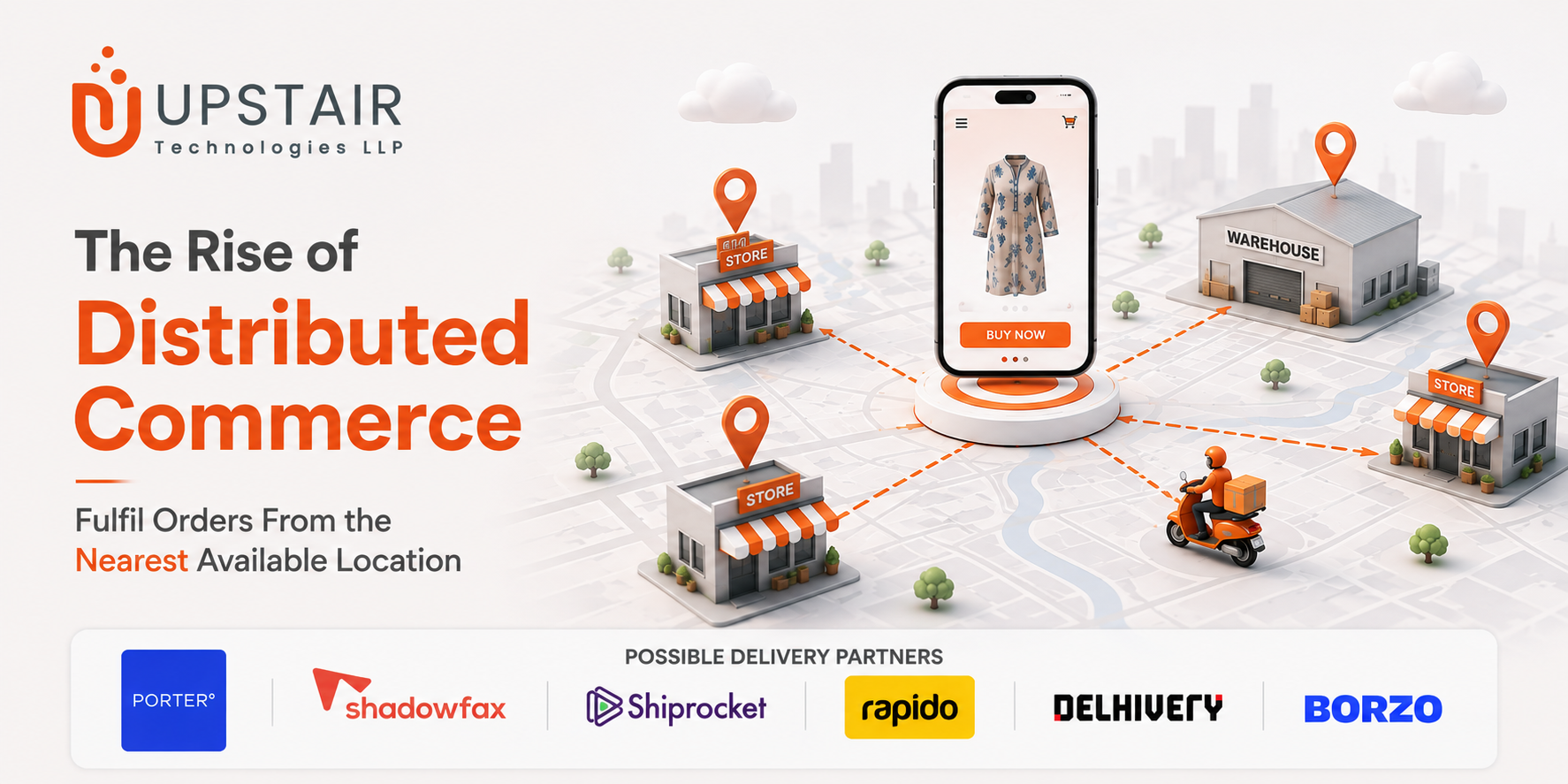
The Rise of Distributed Commerce: Fulfil Orders From the Nearest Available Location
Traditional e-commerce usually follows a simple model: Customer Order → Central Warehouse → Courier → Customer.
But customer expectations are changing. Consumers increasingly expect same-day or even faster delivery, while many retail brands already have the required product sitting in a store close to the customer.
Distributed commerce connects retail stores, warehouses, e-commerce channels and delivery networks so that an order can be fulfilled from the best available location instead of automatically travelling from a central warehouse.
A Retail Store Can Become a Fulfilment Centre
Imagine a customer ordering a product online. The central warehouse may take two or three days to deliver it, but the same product may already be available at a retail store just a few kilometres away.
A distributed commerce platform can identify that inventory and offer the customer faster delivery.
The technology flow can be:
Online Order → Check Store & Warehouse Inventory → Select Best Location → Reserve Stock → Pick & Pack → Book Delivery → Customer
This allows existing retail stores to operate as micro-fulfilment centres without requiring the retailer to build a separate network of warehouses or dark stores.
Last-Mile Delivery Platforms Make This Possible
The other important part of distributed commerce is the last-mile delivery ecosystem.
Instead of depending on a single courier company, a commerce platform can connect with multiple delivery partners and select an appropriate service based on serviceability, delivery time, cost and location.
Delivery platforms can support different fulfilment requirements:
- Intracity and on-demand deliveries
- Store-to-customer local deliveries
- Same-day and express delivery
- Standard e-commerce shipping
- Reverse pickup and return logistics
Platforms such as Porter, Shadowfax, Borzo, Shiprocket Quick, Delhivery, Xpressbees and Blue Dart can serve different logistics requirements depending on the city, delivery type and commercial arrangement.
The platform should avoid being designed around only one delivery company. Instead, it should provide a delivery aggregation layer that can select the most suitable delivery partner for each order.
The delivery workflow can be:
Order Ready → Check Delivery Partners → Compare ETA & Cost → Select Partner → Auto-Book Pickup → Track Delivery
Intelligent Order Routing
The closest store is not necessarily always the best store for fulfilment.
For example, a product may be available at three locations:
- Store A: 2 km away with only 1 piece available
- Store B: 4 km away with 6 pieces available
- Warehouse: 18 km away with 50 pieces available
The system may choose Store B instead of Store A to preserve the last available piece at Store A for walk-in customers.
An intelligent fulfilment engine can consider:
- Inventory availability
- Distance from customer
- Delivery cost
- Estimated delivery time
- Store capacity
- Stock availability and safety levels
- Customer delivery SLA
This makes distributed commerce more than simply “ship from store.” It becomes an intelligent order-routing system that continuously determines the most suitable fulfilment location.
Automated Returns and Reverse Logistics
The same technology can also manage reverse logistics.
A typical return workflow can be:
Customer Requests Return → Validate Request → Select Return Location → Auto-Book Pickup → Track Return → Quality Check → Update Inventory → Refund or Exchange
Where supported by the logistics partner, reverse pickup can be booked automatically through the delivery integration.
The returned product can also be routed to the most appropriate nearby store or warehouse instead of automatically travelling back to a central warehouse.
One Inventory Network for Every Channel
The foundation of distributed commerce is real-time unified inventory.
A modern retailer may sell products through multiple channels:
- Physical retail stores
- Brand website
- Mobile application
- Marketplaces
- Social commerce channels
The technology layer needs to connect the different systems that manage these channels.
Key integrations can include:
- ERP
- POS
- OMS
- Warehouse Management System
- E-commerce platform
- Inventory Management System
- Last-Mile Delivery Platforms
When a store sells the last unit, the online inventory should be updated. Similarly, when an online order reserves inventory from a particular store, the store's available inventory should immediately reflect that reservation.
The Future of E-commerce Is Distributed
The evolution of e-commerce is moving from a traditional warehouse-centric model towards a distributed fulfilment model.
Traditional E-commerce:
Warehouse → Customer
Omnichannel Commerce:
Store + Website + App + Warehouse
Distributed Commerce:
Any Sales Channel → Best Inventory Location → Intelligent Order Routing → Last-Mile Partner → Customer
For retailers with a large physical store network, their stores can become one of their biggest e-commerce advantages.
Instead of treating stores only as sales locations, retailers can transform them into distributed fulfilment points that bring products closer to customers.
The technology connects inventory, orders, stores and delivery partners into one coordinated ecosystem.
One brand. Multiple channels. Distributed inventory. Intelligent fulfilment. Faster delivery.
Certified With The Highly Top-Rated Company
Upstair Technologies Is A Leading IT Company And It Is Certified As The Highly Top-rated Company On Good firms, Clutch, And Upwork. We Also Have A Great Client On Upwork Across The Globe.



Get In Touch With Us
Are You Ready To Grow Your Business With Us?
Drop us a message
We will get back to you as soon as possible.

India

C2-710, Pragati IT Park, Opp AR Mall, Mota Varachha, Surat, Gujarat 394101


USA
108 OGDEN AVE APT 201, JERSEY CITY, NEW JERSEY Zip Code : 07307