The jewellery industry is becoming increasingly complex.
A jewellery business today is no longer simply about purchasing a finished product, adding a margin, and selling it. Retailers, wholesalers, manufacturers, and B2B jewellery suppliers are managing thousands of designs, multiple product variants, fluctuating metal and diamond prices, customer-specific pricing, manufacturing vendors, repairs, inventory across locations, and digital sales channels.
At the same time, customers expect faster quotations, greater customization, transparent pricing, accurate delivery commitments, and digital access to products.
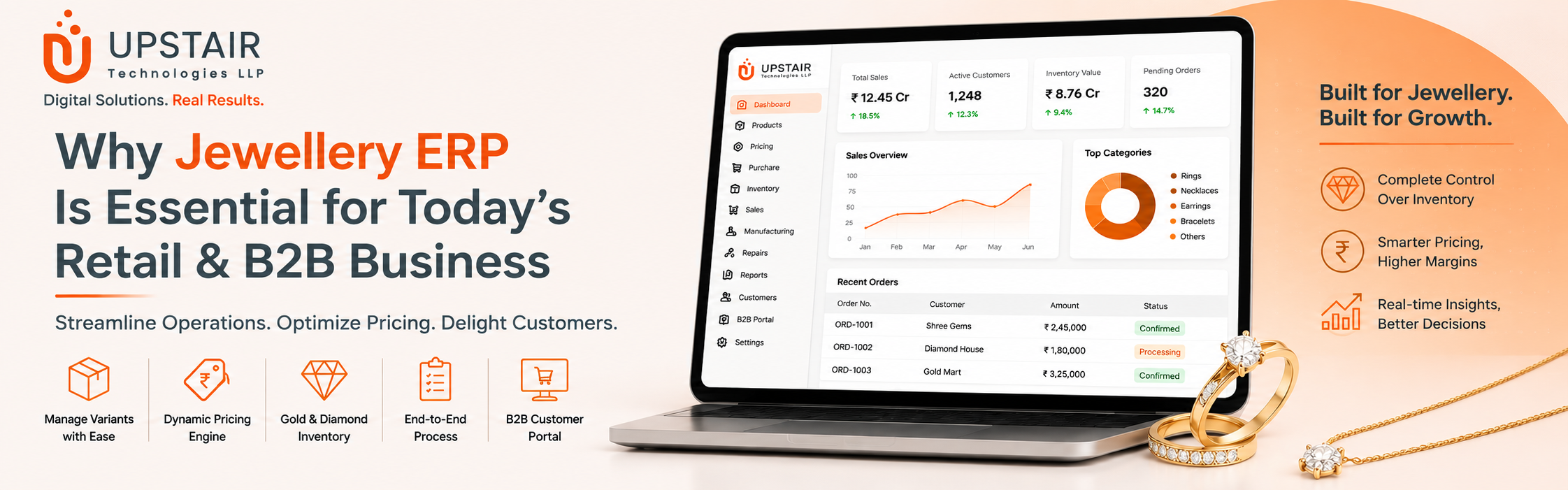
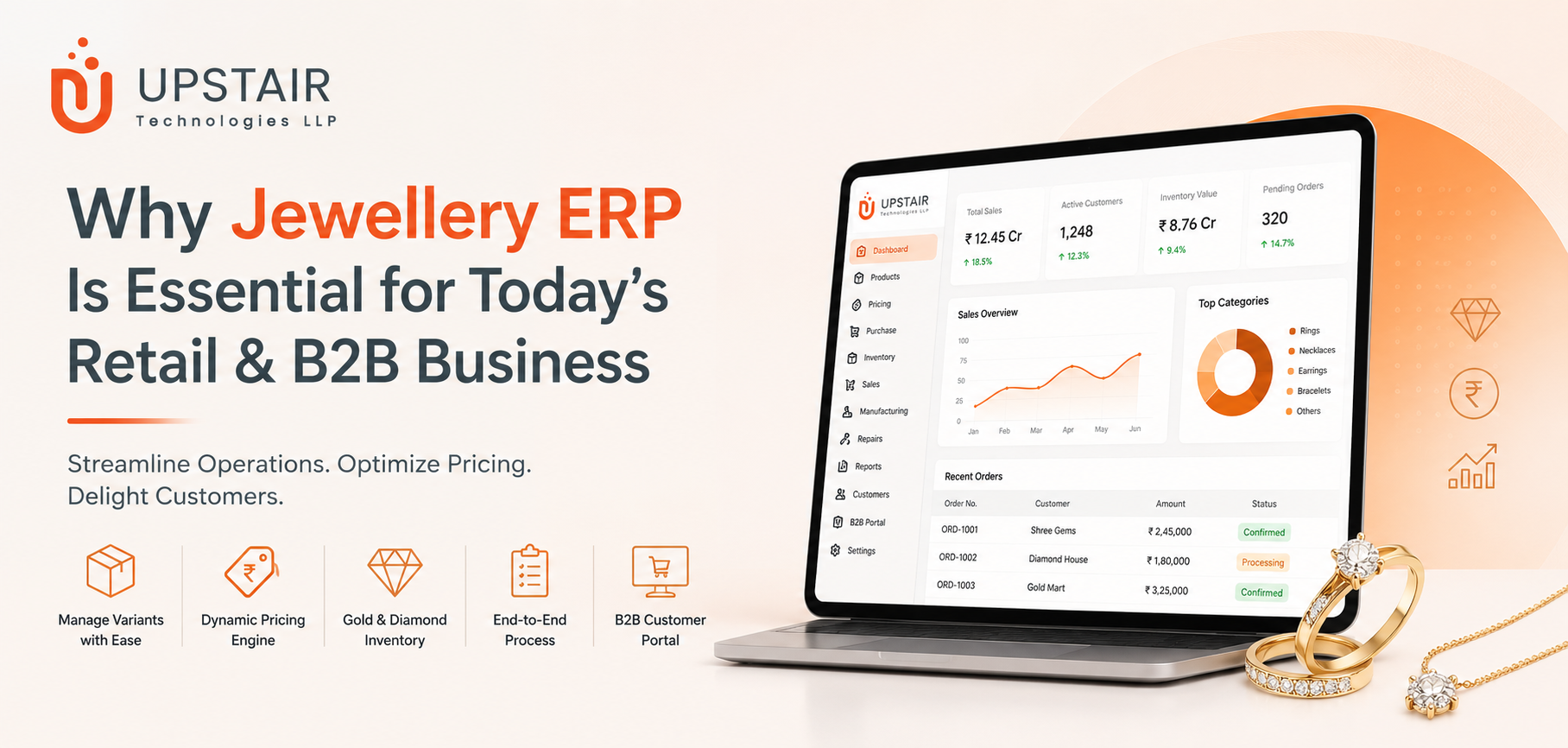
This is why a modern Jewellery ERP (Enterprise Resource Planning) system has become an important foundation for running and scaling a jewellery business.
One Jewellery Design Can Have Hundreds of Variants
Unlike many retail products, a single jewellery design can have a large number of possible configurations.
Consider one diamond ring. The same design may change based on:
- Metal type
- Metal colour
- Metal karat
- Ring size
- Diamond shape
- Diamond colour
- Diamond clarity
- Diamond carat weight
- Diamond quality
- Centre stone size
- Side stone configuration
- Gemstone selection
- Certification requirements
A single design can therefore generate dozens or even hundreds of possible SKUs and variants.
Managing every combination manually becomes difficult as the product catalogue grows.
A Jewellery ERP can maintain a central Style and SKU structure, where variants are dynamically connected with their respective metal, diamond, gemstone, weight, size, and pricing parameters.
Instead of creating disconnected product records, businesses can build a structured product catalogue that is easier to manage across sales, inventory, manufacturing, POS, B2B portals, and e-commerce.
A Robust Price Engine Is at the Heart of Jewellery ERP
Jewellery pricing is significantly more complicated than conventional retail pricing.
The final price may depend on:
Metal Value + Diamond Value + Gemstone Value + Making Charges + Labour + Wastage + Certification + Other Charges + Margin + Taxes
Each component may have its own calculation rules.
The complexity becomes even greater in B2B jewellery businesses.
Different customers may have different:
- Gold rate policies
- Diamond price lists
- Discounts
- Making charges
- Labour rates
- Markups
- Credit terms
- Customer categories
- Contract pricing
This means the same jewellery SKU may have a different selling price for different customers.
A powerful Jewellery ERP with a dynamic pricing engine can automatically calculate the correct price based on the product configuration and customer pricing policy.
Faster Quotations Can Help Win More Business
Speed matters, particularly in competitive B2B jewellery markets.
When a customer asks:
“What would this ring cost in 18KT rose gold with a 1.00-carat oval diamond in a different colour and clarity?”
The salesperson should not have to depend on one experienced pricing person to manually calculate the quotation.
With a Jewellery ERP, an authorized salesperson can select the required configuration and allow the system to calculate the price.
The system already understands the pricing rules.
This enables businesses to provide faster and more consistent quotations, while reducing dependency on individual employees and minimizing manual calculation errors.
A strong ERP effectively converts the company's pricing knowledge into a standardized system.
Purchase Pricing Requires the Same Level of Control
The same complexity exists on the purchase side.
Businesses purchase:
- Gold
- Loose diamonds
- Certified diamonds
- Gemstones
- Findings
- Components
- Finished jewellery
- Semi-finished jewellery
- Manufacturing and job-work services
Different vendors may have different rates, labour charges, wastage policies, payment terms, and manufacturing conditions.
A Jewellery ERP can connect purchase orders, material receipts, invoices, returns, and vendor balances with the corresponding inventory.
This creates much better visibility into the actual landed cost and profitability of jewellery products.
Managing Third-Party Jewellery Manufacturing
Many jewellery businesses outsource part or all of their manufacturing to third-party vendors.
This creates another major operational challenge.
A manufacturer may receive gold, diamonds, and gemstones from the company, perform manufacturing work, consume materials, and return finished jewellery.
The ERP should provide visibility into the complete process:
Job Order → Material Issue → Manufacturing → Material Consumption → Finished Product Receipt → Reconciliation → Vendor Settlement
The business should always know how much gold, diamond, and other material is currently held by each manufacturing vendor.
This is particularly important when valuable inventory is distributed among multiple external manufacturers.
Gold and Diamond Stock Need Specialized Inventory Management
Jewellery inventory cannot be managed like conventional retail inventory.
Gold needs to be tracked by attributes such as purity, weight, and location.
Diamonds may require tracking by:
- Shape
- Carat
- Colour
- Clarity
- Certificate number
- Lab
- Cut
- Polish
- Symmetry
- Location
- Stock status
Businesses may additionally maintain loose diamonds, certified stones, gemstones, finished jewellery, semi-finished products, and metal stock.
A Jewellery ERP creates a centralized inventory system connecting these different inventory types with purchasing, manufacturing, sales, and product costing.
This provides management with a much clearer understanding of where valuable inventory is located and how it is being utilized.
Repair and Service Flow Is Equally Important
Jewellery businesses also need to manage products after the original sale.
Customers may return jewellery for:
- Ring resizing
- Polishing
- Stone replacement
- Diamond tightening
- Rhodium plating
- Chain or clasp repair
- Modification
- General maintenance
A proper Jewellery ERP can create a repair or service memo and track the product throughout its lifecycle:
Customer Receipt → Inspection → Estimate → Approval → Repair/Job Work → Quality Check → Delivery
Photos, product details, customer remarks, expected delivery dates, charges, and repair history can all remain connected to the transaction.
This improves customer service while providing better accountability for high-value products.
New Product Pricing Becomes Much Easier
Launching new products frequently is essential for jewellery brands.
However, every new design needs accurate costing before it can be introduced to customers.
With properly configured product masters and pricing rules, an ERP can calculate the expected price of a new design based on its:
- Expected metal weight
- Diamond requirements
- Gemstone requirements
- Labour
- Making charges
- Wastage
- Other costs
- Required margin
This allows merchandising and sales teams to evaluate products much faster.
Management can also simulate different combinations before approving the product for production or sale.
Jewellery ERP Can Power a B2B Customer Portal
A modern ERP should not remain limited to back-office operations.
It can become the central business engine behind a B2B jewellery website or customer portal.
Authorized customers can log in and:
- Browse jewellery collections
- Search products and styles
- View available inventory
- Configure product variants
- See customer-specific pricing
- Request quotations
- Place orders
- Track order status
- View invoices
- Check outstanding balances
- Download certificates
- Repeat previous orders
Most importantly, pricing displayed on the B2B portal can come directly from the ERP pricing engine.
For example, Customer A and Customer B may open the same jewellery design but see different prices based on their respective commercial agreements.
This transforms a traditional B2B jewellery operation into a 24×7 digital sales platform.
One System Connecting the Entire Jewellery Business
The real advantage of Jewellery ERP is not any individual module. It is the ability to connect the complete jewellery lifecycle.
Product Design → Variant/SKU → Pricing → Purchase → Raw Material → Manufacturing → Inventory → Quotation → Sales Order → Invoice → Customer → Repair & Service
For a modern omnichannel jewellery business, this can extend further:
ERP → Retail POS → B2B Portal → E-commerce → Mobile App → CRM → RFID → Accounting → Analytics
Instead of maintaining separate data and calculations across different departments, the ERP becomes the single source of truth for products, inventory, pricing, customers, and transactions.
From Operational Software to a Business Intelligence Platform
Once business operations are properly structured inside an ERP, management can obtain much deeper insights.
The business can understand:
- Which designs are selling fastest?
- Which variants are performing better?
- Which inventory is slow-moving?
- How much gold and diamond stock is available?
- How much material is lying with each manufacturer?
- Which B2B customers generate the highest revenue?
- Which products generate the highest margins?
- Which quotations are converting into orders?
- Which products should be replenished?
- What is the current inventory valuation?
This is where ERP moves beyond transaction management and starts supporting business decisions.
The Future: AI-Powered Jewellery ERP
The next evolution will be AI-powered Jewellery ERP.
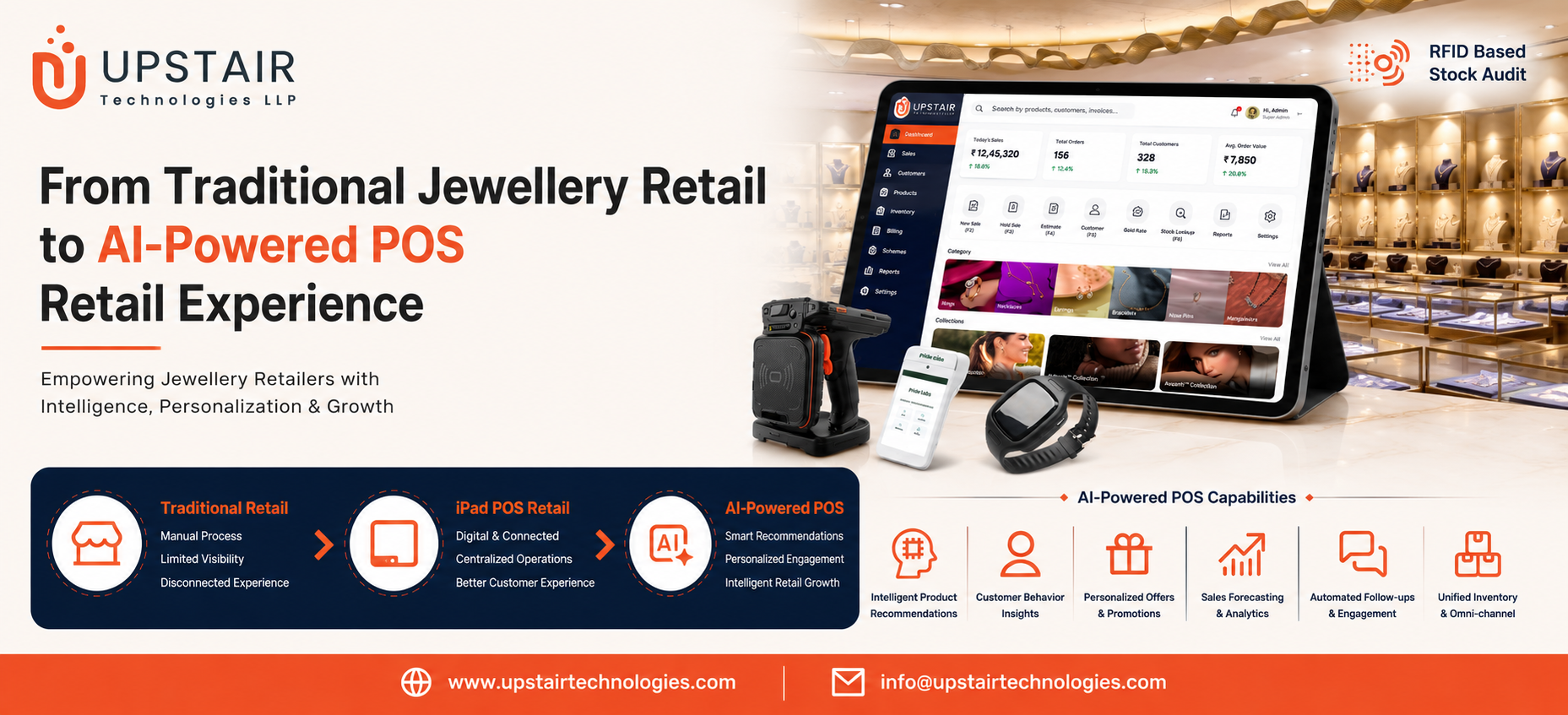
Once product, pricing, customer, inventory, and sales information is structured properly, AI can sit on top of the ERP and help teams interact with business data naturally.
A salesperson could ask:
- “Find similar rings available in 18KT white gold.”
- “Calculate the price of this design with a 1.5-carat oval diamond.”
- “Show alternatives within the customer's budget.”
- “Which quotations from this month still require follow-up?”
Management could ask:
- “Show slow-moving diamond jewellery above ₹2 lakh.”
- “Which B2B customers have reduced their purchases this quarter?”
- “What should we manufacture or replenish next month?”
The quality of such AI capabilities ultimately depends on the quality and structure of the underlying ERP data.
Conclusion
For today's jewellery retailer, wholesaler, manufacturer, or B2B supplier, ERP is becoming much more than accounting or inventory software.
It is the digital backbone of the jewellery business.
A modern Jewellery ERP should be capable of handling complex product variants, dynamic pricing, customer-specific B2B pricing, quotations, purchases, gold and diamond inventory, third-party manufacturing, repair workflows, new product costing, and digital B2B sales.
As jewellery businesses expand across stores, customers, manufacturers, and digital channels, managing these processes manually becomes increasingly difficult.
Businesses that build a strong ERP foundation today will be better prepared for the next generation of omnichannel commerce, automation, real-time analytics, and AI-powered jewellery operations.