Inventory management is one of the most critical parts of running a successful jewellery business. From individual rings and earrings to necklaces, bracelets, loose diamonds, and high-value collections, every item needs to be accurately tracked throughout its lifecycle.
For many years, barcode systems have been the standard method for identifying and managing jewellery inventory. However, with the growing demand for faster operations, real-time inventory visibility, and better customer experiences, RFID technology is becoming an increasingly attractive option for jewellery retailers and manufacturers.
So, which technology is better for jewellery inventory management: traditional barcode or RFID?
The answer depends on the size of your business, inventory complexity, operational requirements, and the level of automation you want to achieve.
What is Barcode-Based Jewellery Inventory Management?
A barcode system uses a unique printed barcode or QR code assigned to each jewellery item. The barcode contains an identification number that is linked to product information stored in the jewellery ERP, POS, or inventory management system.
When a jewellery item needs to be received, transferred, sold, or counted, a salesperson or inventory operator scans the barcode using a barcode scanner or mobile device.
Barcode systems can help jewellery businesses manage:
- Product identification.
- Stock receiving.
- Sales transactions.
- Stock transfers.
- Product returns.
- Inventory counting.
- Product location tracking.
- Barcode-based billing.
Barcode technology is relatively simple, affordable, and widely supported by existing ERP and POS systems.
What is RFID-Based Jewellery Inventory Management?
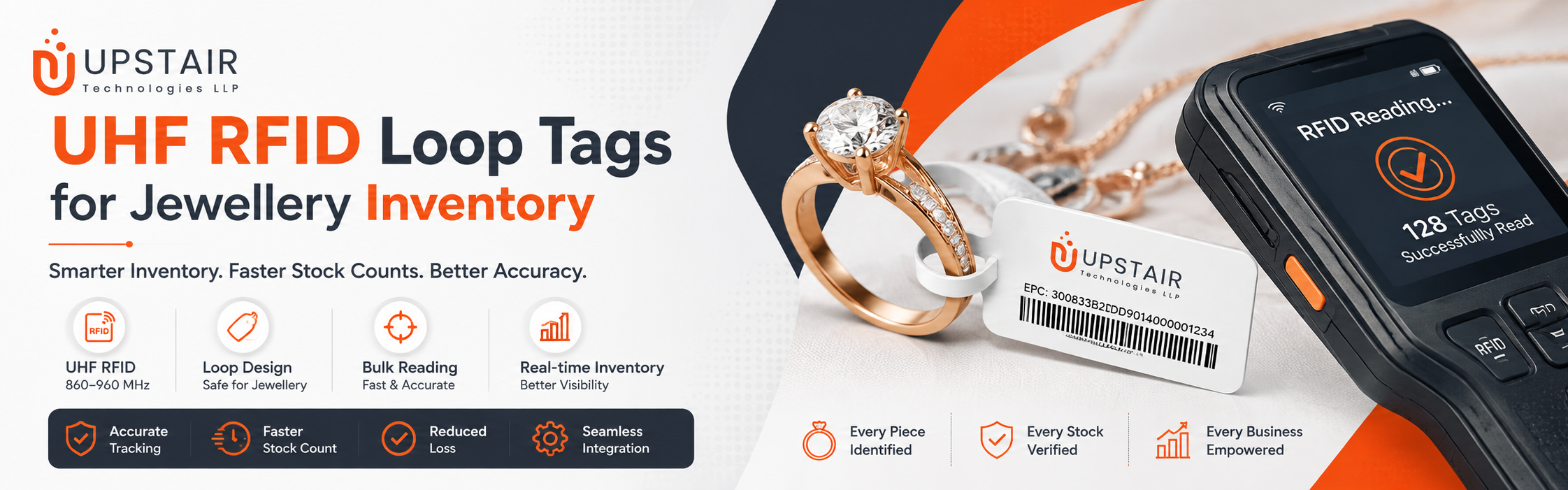
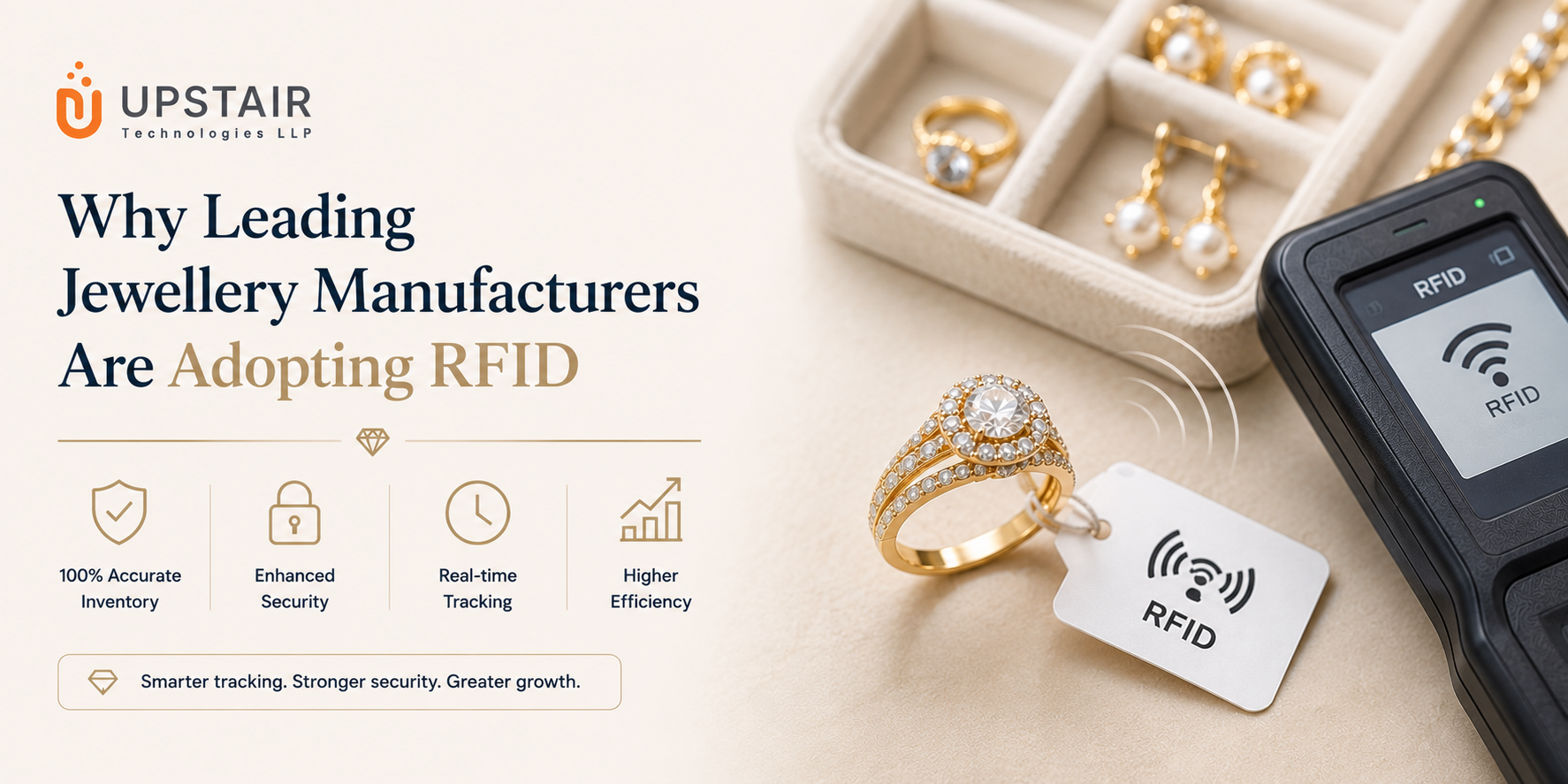
RFID stands for Radio Frequency Identification. Instead of relying on a visible barcode that must be scanned individually, RFID uses a small electronic tag containing a unique identification number.
The RFID tag communicates with an RFID reader through radio frequency technology. This allows jewellery businesses to identify tagged products without requiring direct line-of-sight between the tag and the reader.
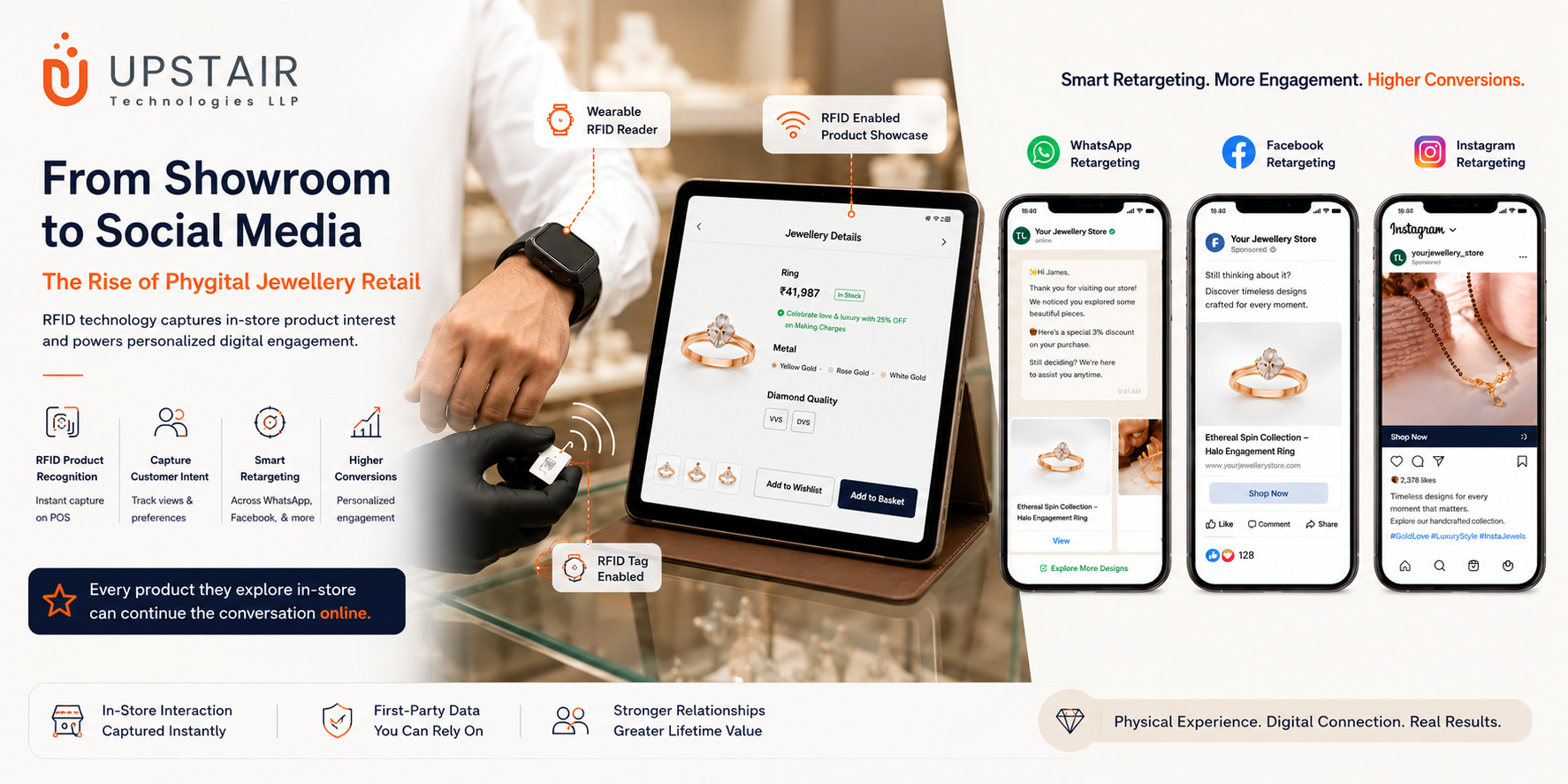
When RFID is integrated with jewellery ERP, POS, and inventory systems, businesses can automatically capture product movement and improve inventory visibility.
RFID can be used for:
- Automated inventory counting.
- Stock receiving and dispatch.
- Showroom inventory monitoring.
- Inter-store stock transfers.
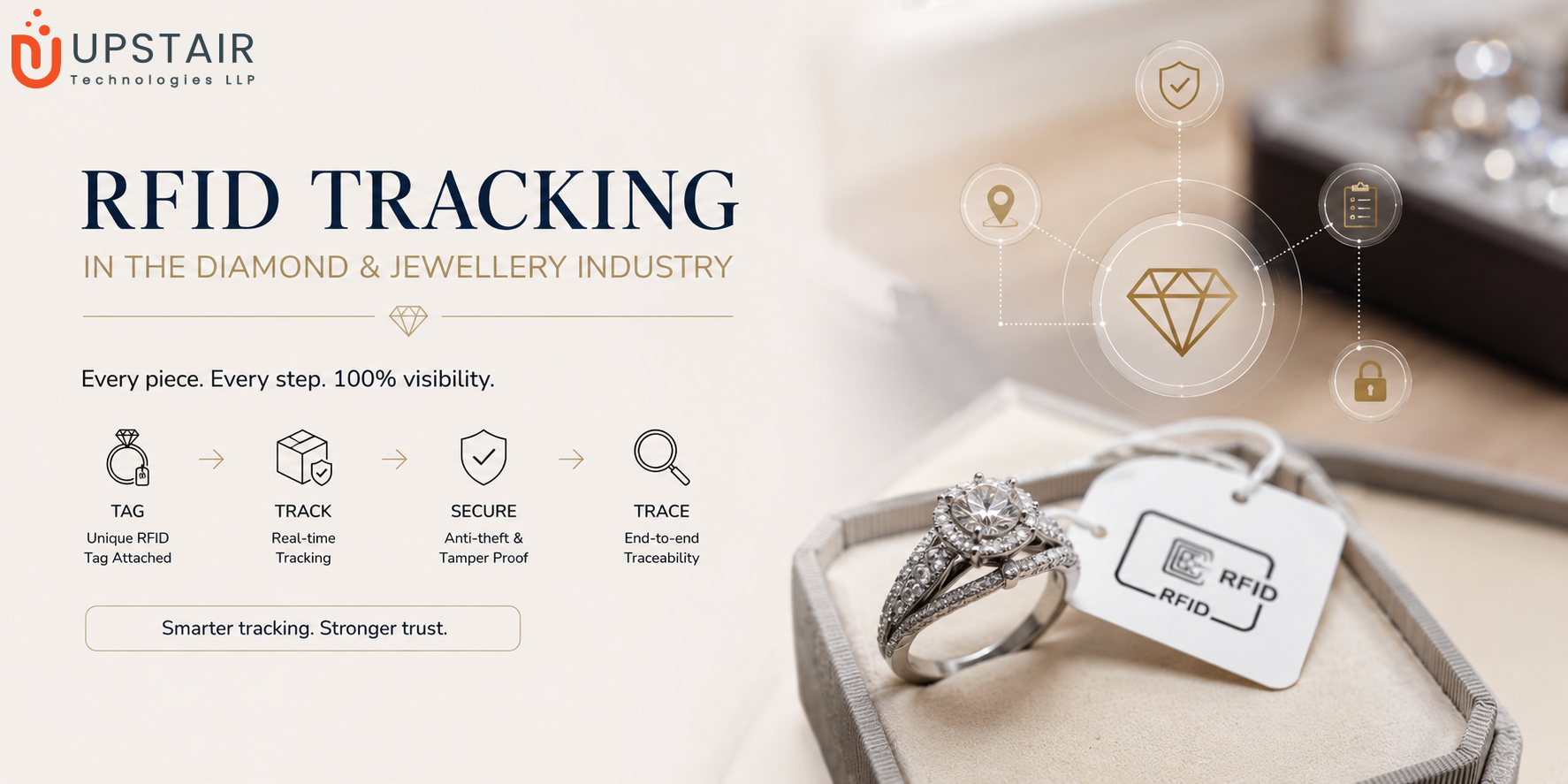
- Product movement tracking.
- Stock verification.
- Missing item identification.
- Inventory audits.
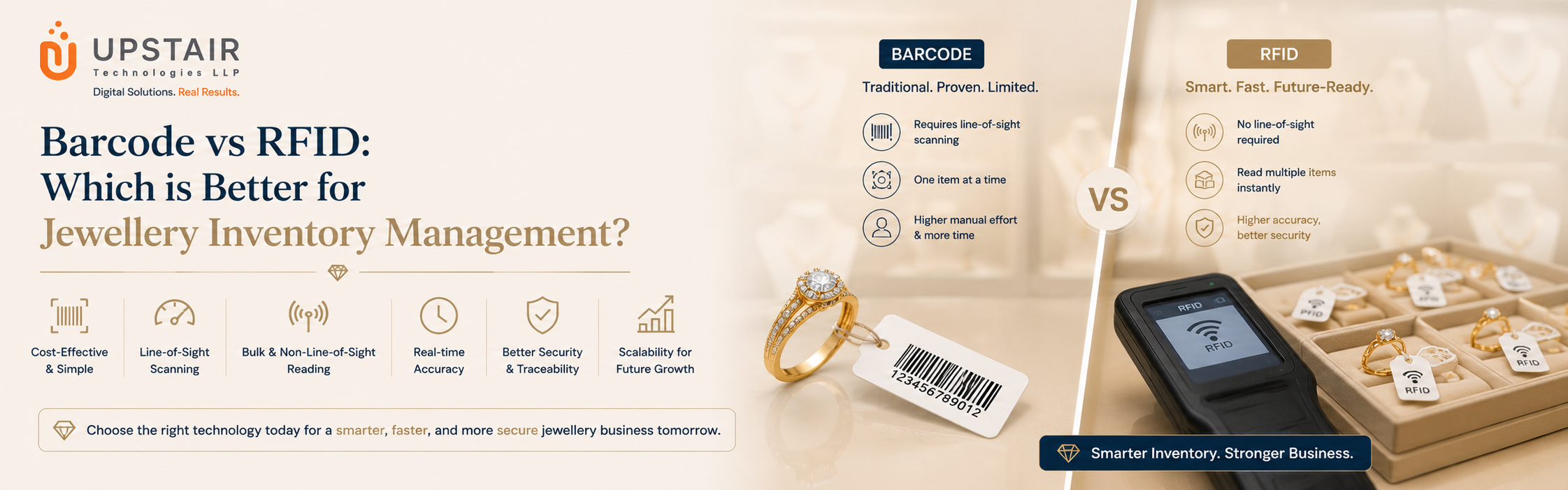
Barcode vs RFID: How Do They Work?
The biggest difference between the two technologies is the way products are identified.
Barcode:
A barcode scanner needs to visually capture the barcode printed or attached to the jewellery item. The operator generally needs to point the scanner toward each barcode individually.
RFID:
An RFID reader communicates with RFID tags using radio waves. Multiple tagged items can potentially be identified within the reader's range without requiring each item to be manually scanned one at a time.
Barcode vs RFID for Jewellery Inventory
Both technologies can improve inventory management, but their capabilities are different.
1. Scanning Speed
Barcode systems generally require individual scanning. If a jewellery store has hundreds or thousands of items, manually scanning each item can take significant time.
RFID can identify multiple tagged items in a reading area, making stock counting and verification significantly faster.
2. Line-of-Sight Requirement
Barcodes normally need to be visible to the scanner. If the barcode is covered, damaged, facing the wrong direction, or placed inside packaging, scanning can become inconvenient.
RFID does not require the same direct visual alignment. This makes RFID particularly useful for bulk inventory checking.
3. Inventory Accuracy
Barcode systems can provide excellent accuracy when products are scanned correctly. However, manual scanning introduces the possibility of human error, such as missing an item or scanning the wrong product.
RFID can reduce manual intervention and automate more of the inventory identification process, helping businesses improve inventory accuracy.
4. Inventory Counting
Traditional barcode stock counting can require employees to scan jewellery pieces individually and reconcile the scanned products with the ERP inventory.
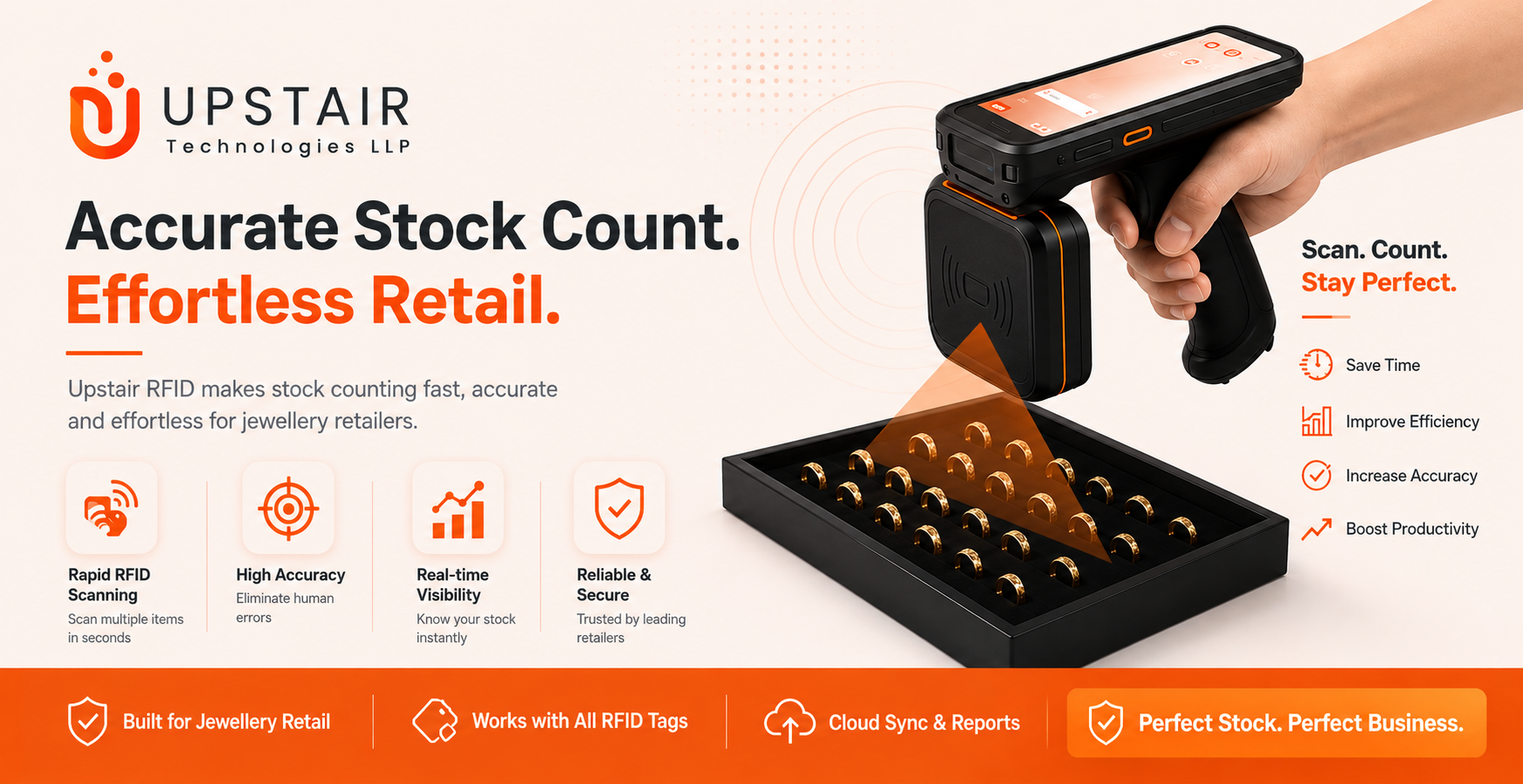
With RFID, businesses can place tagged products within an RFID reading zone and quickly identify multiple products. This can significantly reduce the time required for periodic inventory audits.
5. Product Movement Tracking
Barcode technology can track product movement when an employee scans an item at each stage. However, every movement needs to be recorded through a scanning action.
RFID can support more automated tracking when RFID readers are installed at appropriate locations such as stockrooms, entrances, counters, or dispatch areas.
Barcode vs RFID: Comparison
- Identification: Barcode uses optical scanning, while RFID uses radio-frequency communication.
- Scanning: Barcode generally requires individual scanning, while RFID can identify multiple tagged items within a reading zone.
- Line of sight: Barcode generally requires visibility, while RFID does not require the same direct visual alignment.
- Inventory counting: Barcode is more manual, while RFID can automate bulk counting.
- Implementation cost: Barcode solutions are generally less expensive to deploy.
- Automation: RFID offers greater opportunities for automated inventory tracking.
- Existing compatibility: Barcode is widely supported by conventional POS and ERP systems.
- Operational efficiency: RFID can provide significant efficiency improvements for large and complex inventories.
Why Barcode Still Makes Sense for Many Jewellery Businesses
RFID offers several advantages, but that does not mean barcode technology is outdated or unsuitable for jewellery businesses.
For smaller jewellery stores with limited inventory, barcode systems can be a practical and cost-effective solution.
Barcode may be the right choice when:
- The inventory volume is relatively small.
- Manual scanning is manageable.
- The business already has a barcode-enabled POS or ERP system.
- The business has a limited budget for inventory automation.
- Real-time automated stock tracking is not required.
Barcode technology can continue to provide reliable inventory management when implemented correctly.
Why RFID is Becoming Important for Jewellery Retail
Jewellery businesses often manage thousands of unique products with different designs, weights, purity levels, stones, certifications, pricing, and stock locations.
As inventory becomes larger and operations become more complex, manually scanning every item becomes increasingly time-consuming.
RFID becomes particularly valuable when businesses need:
- Faster inventory audits.
- Real-time stock visibility.
- Automated product identification.
- Reduced manual scanning.
- Better stock movement tracking.
- Multi-store inventory visibility.
- Faster stock reconciliation.
- Improved operational efficiency.
RFID and Jewellery ERP: A Powerful Combination
RFID delivers the greatest value when it is integrated directly with the jewellery ERP and inventory management system.
For example, when a jewellery item enters a showroom, an RFID reader can identify the item and communicate its unique tag ID to the inventory system.
The ERP can then associate that RFID tag with information such as:
- Product code.
- Design number.
- Category.
- Gold or metal type.
- Gross weight.
- Net weight.
- Diamond or gemstone details.
- Purity.
- Making charges.
- Current selling price.
- Stock location.
- Branch or showroom.
This creates a connected inventory ecosystem where physical jewellery and digital inventory records remain closely synchronized.
RFID for Multi-Store Jewellery Businesses
Managing inventory across multiple stores can be challenging. Jewellery may frequently move between branches based on customer demand, stock requirements, exhibitions, repairs, or special orders.
With a properly integrated RFID system, businesses can improve visibility into where products are located and simplify stock verification during inter-store transfers.
A multi-store RFID solution can help businesses monitor:
- Which showroom currently has a product.
- Products transferred between branches.
- Products received at another store.
- Products available in the central warehouse.
- Items that are physically present but missing from system records.
- Items recorded in the ERP but not physically located during an audit.
This level of visibility can help management make better inventory decisions across the entire retail network.
RFID Can Transform Jewellery Stock Audits
Stock audits are an important part of jewellery retail operations. However, traditional inventory verification can consume significant employee time.
Employees may need to take jewellery items out of trays, scan or enter individual product information, compare records, and investigate discrepancies.
RFID can simplify this process by allowing multiple tagged products to be identified within a reading zone.
This can help retailers:
- Complete inventory checks faster.
- Identify missing products.
- Find unexpected products.
- Reduce manual data entry.
- Improve stock reconciliation.
- Reduce disruption to showroom operations.
Can Jewellery Businesses Use Both Barcode and RFID?
Yes. Jewellery businesses do not necessarily need to choose only one technology.
A hybrid approach can combine barcode and RFID depending on the business process.
For example:
- Barcode can be used for billing and conventional POS operations.
- RFID can be used for stock audits and inventory movement.
- Barcode can remain available as a backup identification method.
- RFID can provide automated inventory visibility.
- Both technologies can be connected to the same ERP system.
This approach allows businesses to modernize inventory management without completely replacing their existing systems.
Which is Better: Barcode or RFID?
There is no single answer for every jewellery business.
Barcode is better when affordability, simplicity, and conventional scanning are the primary requirements.
RFID is better when speed, automation, inventory visibility, and large-scale stock management are priorities.
For small jewellery stores, barcode may provide everything required. For large retailers, manufacturers, wholesalers, and multi-store jewellery businesses, RFID can provide significantly greater opportunities for automation and operational efficiency.
The Future of Jewellery Inventory Management
The future of jewellery inventory management is moving toward connected and intelligent systems. RFID, ERP, POS, CRM, analytics, AI, and e-commerce platforms can work together to create a complete digital ecosystem.
Future-ready jewellery businesses will increasingly focus on:
- Real-time inventory visibility.
- Automated stock reconciliation.
- AI-powered inventory analytics.
- RFID-based product identification.
- Multi-store inventory synchronization.
- Automated stock movement tracking.
- Integrated ERP and POS platforms.
- Data-driven purchasing and replenishment.
The goal is not simply to replace barcode scanners with RFID readers. The real opportunity is to create a smarter inventory system where every jewellery item can be digitally identified, tracked, and connected to the business ecosystem.
How Upstair Technologies Can Help
At Upstair Technologies, we help jewellery manufacturers, wholesalers, and retailers adopt modern technology for better inventory control and operational efficiency.
Our jewellery technology solutions can include:
- Jewellery ERP Software.
- POS Software.
- RFID Inventory Management.
- Barcode-Based Inventory Systems.
- Multi-Store Inventory Management.
- CRM Integration.
- E-commerce Integration.
- Stock Transfer Management.
- Inventory Audit Solutions.
- Custom Jewellery Software Development.
By integrating RFID or barcode technology with jewellery ERP and POS systems, businesses can improve stock visibility, reduce manual processes, and create a more efficient retail operation.
Conclusion
Barcode and RFID both have an important role in jewellery inventory management. Barcode technology remains a reliable, affordable, and widely supported solution, while RFID provides greater automation, speed, and inventory visibility.
For businesses managing a small inventory, barcode may be the most practical option. For large jewellery manufacturers, wholesalers, retailers, and multi-store chains, RFID can provide substantial advantages in stock counting, movement tracking, and inventory reconciliation.
The real question is not simply “Barcode or RFID?” It is “How can technology help us manage jewellery inventory faster, more accurately, and more intelligently?”
As jewellery retail continues to become more technology-driven, businesses that invest in connected inventory management systems will be better positioned to improve efficiency, reduce operational challenges, and deliver a superior customer experience.